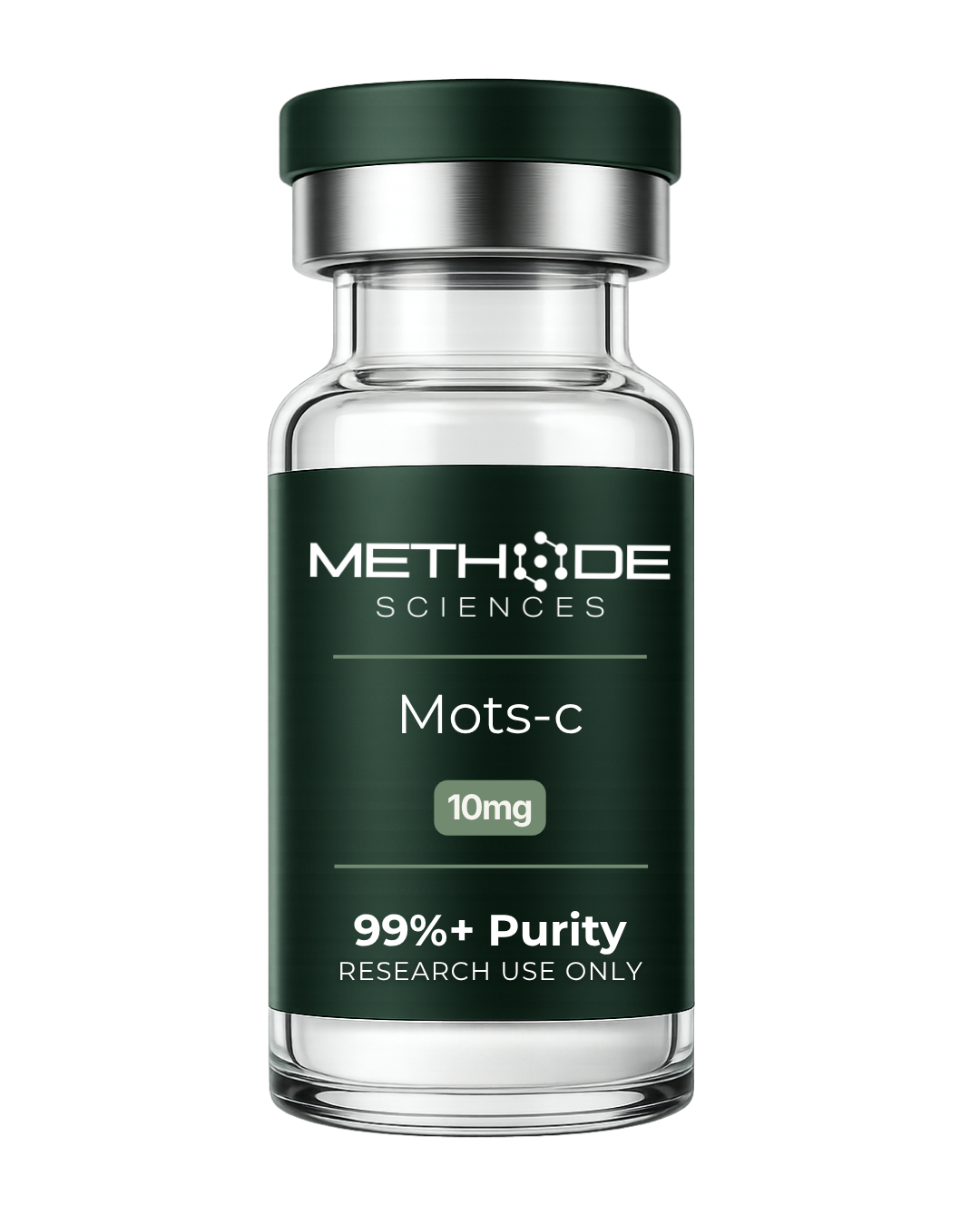
Sixteen-residue peptide encoded within the mitochondrial 12S rRNA gene --- one of the few known mitochondrial-derived peptides. Studied in AMPK activation, insulin sensitivity, skeletal-muscle metabolism, and age-related metabolic decline. 99%+ purity confirmed by independent HPLC-MS; lot COA published before sale.
Independent laboratory testing confirms purity and composition of this research material.
MOTS-c (mitochondrial open reading frame of the 12S rRNA type-c) was identified in 2015 by Changhan Lee and Pinchas Cohen’s group at USC as a peptide translated from a short open reading frame inside the mitochondrial genome. Its discovery expanded the known coding capacity of mitochondrial DNA and established a new class of signaling molecules — mitochondrial-derived peptides — that communicate mitochondrial status to the rest of the cell, including the nucleus. Circulating MOTS-c levels decline with age, and a common polymorphism in the sequence has been associated with longevity in Japanese populations.
| Sizes | 10 mg, 40 mg lyophilized powder, 3 mL clear glass vial |
|---|---|
| Purity | ≥ 99% by HPLC; identity confirmed by LC-MS |
| Sequence | Met-Arg-Trp-Gln-Glu-Met-Gly-Tyr-Ile-Phe-Tyr-Pro-Arg-Lys-Leu-Arg |
| Molecular formula | C₁₀₁H₁₅₂N₂₈O₂₂S₂ |
| Molecular weight | 2,174.6 Da |
| CAS | 1627580-64-6 |
| Appearance | White to off-white lyophilized powder |
| Solubility | Water |
| Storage | −20 °C long term; 2–8 °C short term |
| Testing | Lot-specific COA from Janoshik Analytical |
In the original Cell Metabolism work, MOTS-c prevented diet-induced obesity and insulin resistance in mice and improved glucose handling in skeletal muscle — the basis for its use in metabolic-disease models.
MOTS-c is released from muscle during exercise and, in aged mice, improved physical capacity; it is studied as a candidate “exercise mimetic” and as a mediator of exercise adaptation.
Under metabolic stress, MOTS-c translocates to the nucleus and regulates adaptive gene expression — a model system for retrograde signaling from mitochondria.
Work in aged animals and in cells examines MOTS-c’s role in maintaining metabolic flexibility and resistance to oxidative and metabolic stress.
MOTS-c inhibits the folate–methionine cycle, leading to accumulation of AICAR and activation of AMPK — the master energy sensor — which shifts cells toward glucose uptake and fatty-acid oxidation. Under stress it also enters the nucleus and binds antioxidant-response elements in partnership with transcription factors such as NRF2, modulating stress-adaptive gene programs.
The discovery paper is Lee et al. (2015, Cell Metabolism). Nuclear translocation and stress signaling are described in Kim et al. (2018, Cell Metabolism); exercise and aging effects in Reynolds et al. (2021, Nature Communications). The longevity-associated polymorphism (m.1382A>C) is reported in Fuku et al. (2015, Aging Cell).
It behaves like one — secreted into circulation, acting on distant tissues — but it is unusual in being encoded by mitochondrial rather than nuclear DNA.
The 40 mg vial is the more economical option for extended protocols and keeps the lot constant across an experiment.
Match the lot number on your vial to the COA on the Lab Results page.
Every lot is analyzed by Janoshik Analytical, an independent accredited laboratory, before listing. Testing covers identity (LC-MS), purity (HPLC), net content, and endotoxin (LAL assay, USP <85>). The COA is published to the Lab Results page before the lot goes on sale.
Sealed lyophilized vials remain stable up to 24 months at −20 °C. Refrigerate at 2–8 °C on arrival and for short-term holding, protected from light and moisture. Avoid repeated freeze–thaw cycles.
Orders paid before 12 PM PST dispatch within 24 hours. Most arrive in 2–3 business days. Free shipping over $199; $14.99 flat below. US and Puerto Rico only. All sales final; damaged or incorrect orders replaced within 7 days with photos.
US-based support 7 days a week at info@methodesciences.com for orders, tracking, COAs, and institutional purchasing. Support covers orders and documentation only — protocol design is the researcher's responsibility.